

Organizations continue to rely on familiar hiring techniques that appear logical but fail to predict job performance accurately. Despite technological advancement in every other business function, these popular hiring methods often remain rooted in outdated practices.
The result? Costly hiring mistakes, inconsistent decision-making, and overlooked high-potential candidates.
At The Talent Games, we advocate for evidence-based, performance-driven hiring powered by gamified assessments, because hiring decisions should be based on measurable ability, not assumptions.
The Hiring Methods Companies Use Most — Ranked by Predictive Accuracy
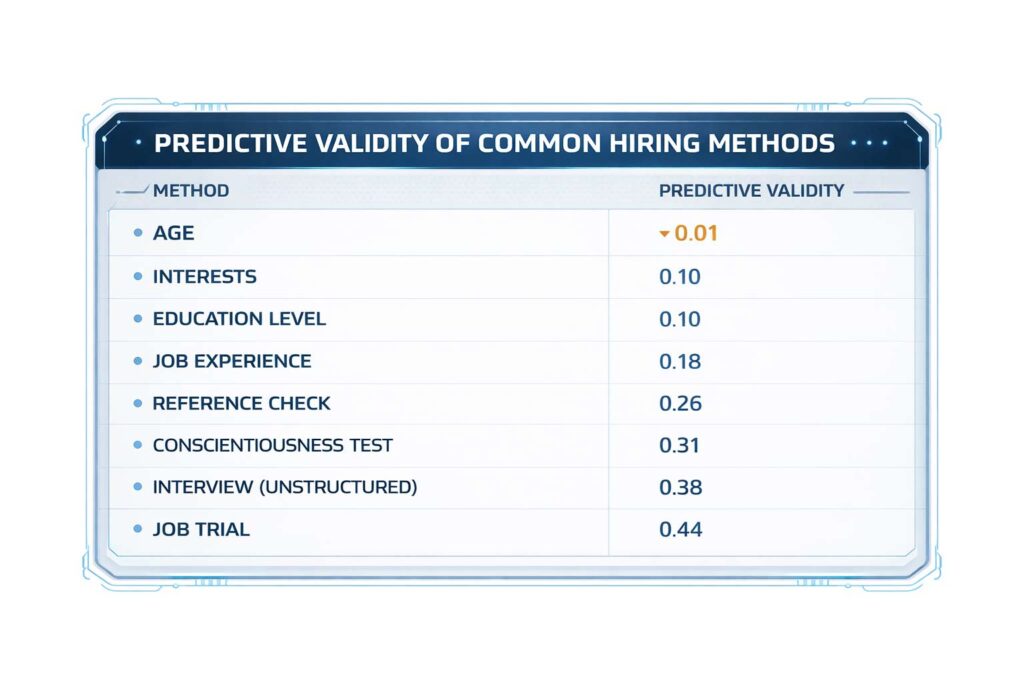
Not all hiring methods are equally effective. Industrial-organizational research has long measured predictive validity which is the extent to which a hiring tool forecasts actual job performance.
When ranked from lowest to highest predictive accuracy, many widely used methods perform surprisingly poorly.
Below is a breakdown of commonly used hiring techniques, and how well they actually work.
Years of Experience
Experience is often treated as a proxy for competence. However, research shows that the number of years spent in a role has only a weak correlation with future performance.
Time in a job does not necessarily translate into skill mastery, adaptability, or problem-solving ability. Overvaluing tenure can eliminate capable candidates who may learn quickly and outperform more experienced peers.
Education Level
Degrees and academic credentials are frequently used as screening filters. While education can signal foundational knowledge, its ability to predict job performance is limited.
Many high performers emerge from non-traditional paths. Rigid academic filters often exclude diverse and capable candidates without providing meaningful insight into how they will perform in the role.
Interests and Personal Background Factors
Some hiring processes evaluate hobbies, extracurricular interests, or demographic factors. These elements contribute little to predicting job effectiveness.
Personal interests may enrich a resume but rarely provide measurable evidence of workplace competence. Decisions based on such factors risk introducing bias rather than insight.
Reference Checks
Reference checks are common, yet their value depends heavily on the willingness and honesty of the referee. Former employers may provide limited or overly cautious feedback, reducing the usefulness of the information gathered.
As a result, reference checks tend to add minimal predictive power to the overall hiring decision.
Unstructured Interviews
Unstructured interviews are informal conversations without standardized scoring and they remain one of the most widely used hiring methods.
However, they are highly subjective. Different interviewers may draw different conclusions about the same candidate. Personal bias, first impressions, and conversational chemistry often overshadow objective evaluation.
Despite their popularity, unstructured interviews provide limited consistency and moderate predictive value at best.
Personality Assessments
Many organizations rely on personality tests to evaluate cultural fit or behavioral tendencies.
While structured and validated personality tools can add value in certain contexts, many commonly used assessments lack strong scientific backing. Broad personality measures often fail to directly link traits with specific job performance outcomes.
Used in isolation, personality assessments rarely provide a reliable basis for hiring decisions.
Structured Interviews
Structured interviews represent a significant improvement over informal conversations. In this format, candidates are asked the same predefined questions, and responses are evaluated using standardized scoring criteria.
This consistency reduces bias and increases fairness. Structured interviews demonstrate stronger predictive validity compared to unstructured approaches, making them a more reliable component of a hiring framework.
Cognitive Ability Tests
Cognitive ability — including reasoning, problem-solving, and learning agility — is one of the strongest predictors of job success across industries.
Candidates who demonstrate high cognitive capability tend to adapt faster, learn efficiently, and perform effectively in complex environments. Objective cognitive testing provides measurable insight that resumes and interviews cannot capture.
Work Sample Tests
Work sample tests require candidates to perform tasks directly related to the role. Because they simulate real job responsibilities, they offer one of the highest levels of predictive accuracy.
When candidates demonstrate their ability to complete relevant tasks successfully, employers gain clear evidence of competence.
However, traditional work samples can be time-intensive and difficult to scale in high-volume hiring environments.
Combining Methods Produces Better Hiring Outcomes
No single hiring method is perfect. The strongest results emerge when organizations combine multiple high-validity approaches.
For example:
- Cognitive assessments identify problem-solving ability.
- Work simulations demonstrate applied skill.
- Structured interviews provide contextual understanding.
When layered strategically, these methods significantly improve hiring accuracy and reduce costly errors.
How The Talent Games Delivers Evidence-Based Hiring
At The Talent Games, we integrate the most scientifically reliable elements of hiring into scalable gamified assessments.
Our platform combines:
- Cognitive measurement
- Behavioral simulation
- Role-based scenarios
- Structured scoring frameworks
Through immersive game mechanics, candidates complete realistic challenges that mirror job demands. This approach captures real performance data rather than relying on resume claims or conversational impressions.
Gamified assessments also enhance candidate engagement, reduce drop-off rates, and standardize evaluation — helping organizations make faster, fairer decisions.
Instead of relying on outdated methods with low predictive value, companies can adopt a data-driven system that measures what truly matters: demonstrated ability.
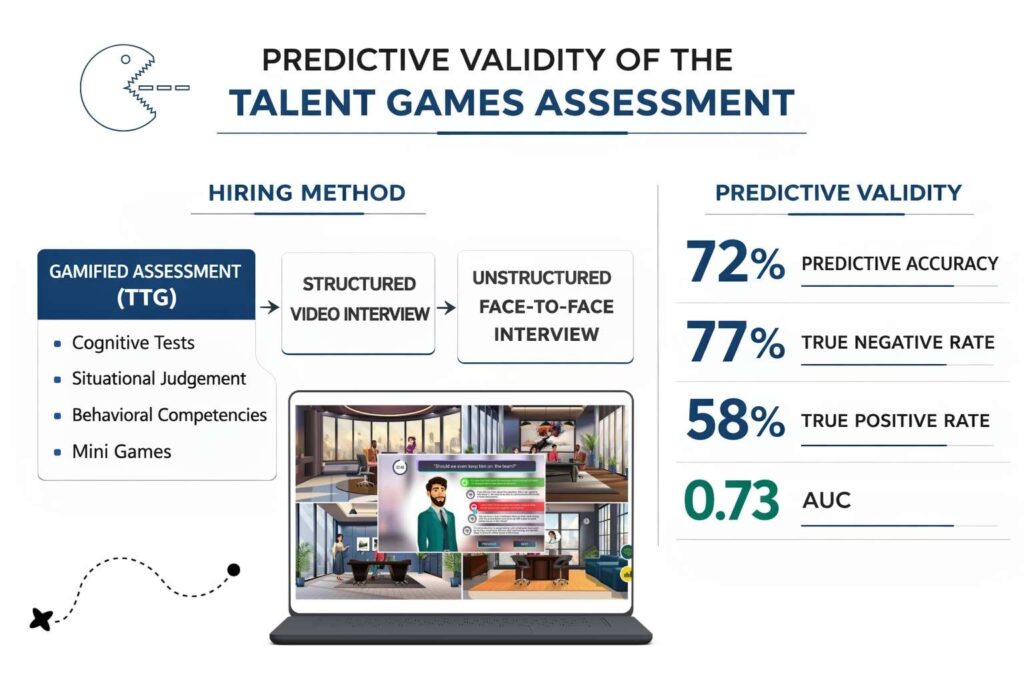
Check how Large Asian Bank achieved high predictive validity using gamified assessments. Download Case Study.
Moving Beyond Guesswork in Hiring in 2026
Traditional hiring methods continue to dominate recruitment processes largely due to familiarity, not effectiveness. Research shows that relying solely on resumes, unstructured interviews, or background factors offers limited predictive accuracy.
The strongest hiring outcomes emerge from a hybrid assessment strategy — one that combines cognitive evaluation, structured interviews, and job-relevant simulations.
By integrating these high-validity methods within a scalable, gamified framework, The Talent Games enables organizations to make more balanced, data-driven hiring decisions.
The future of hiring does not lie in replacing one method with another — but in intelligently combining multiple now AI evidence-based tools to maximize predictive accuracy and hiring success.