

Imagine this: you’ve spent weeks reviewing candidates for a management trainee program. One applicant aces every technical assessment, dominates every cognitive test, and tops every competency score. On paper, they are perfect. Yet, six months into the role, they struggle to adapt, miss deadlines, and clash with teammates. Meanwhile, another candidate who barely made the top 50% in assessments thrives, leading projects and earning accolades for creativity and collaboration.
This scenario isn’t rare. In fact, traditional methods such as unstructured interviews show relatively low predictive power, with a validity of only around 0.38. Your candidate’s abilities on a test are only part of the equation. What assessments frequently miss are the underlying traits, behaviors, and adaptability that truly define top performers. Understanding these nuances is critical for building teams that excel not just on paper, but in practice.
High-potential candidates bring more than knowledge or technical skills—they bring curiosity, resilience, and the ability to navigate complex workplace dynamics. Traditional assessments can measure competencies such as focus, reasoning, and domain-specific skills, but they rarely capture soft skills or behavioral tendencies that drive real-world success. This gap is where a nuanced approach to hiring becomes essential.
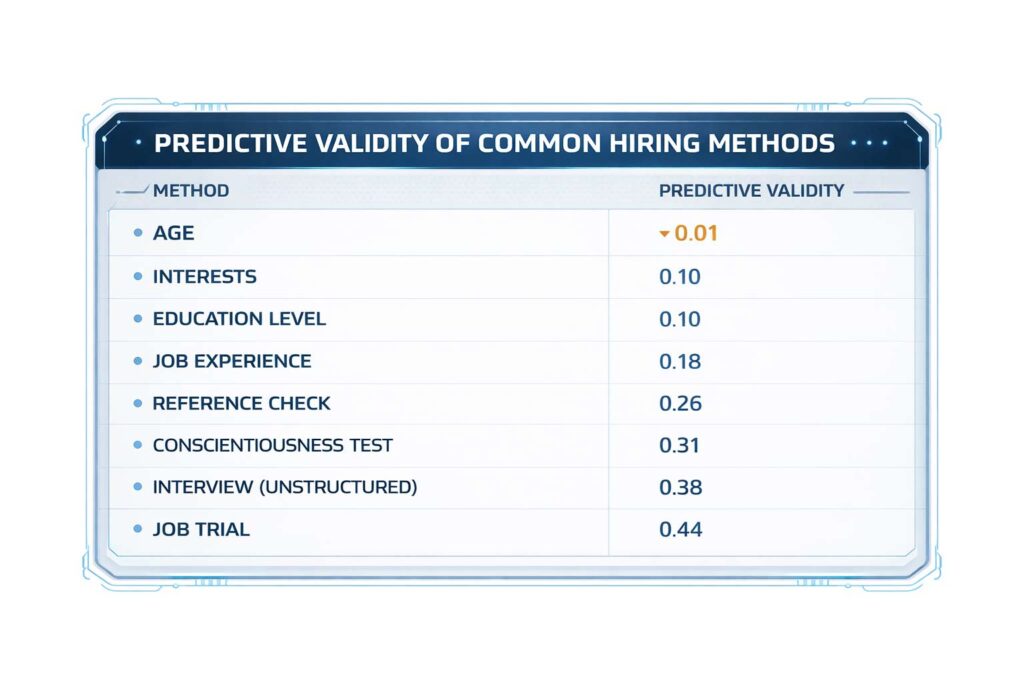
Predictivity of Gamified-Assessments (Case Study)
What Assessments Can Measure – and What They Often Miss
Assessments are effective at evaluating technical knowledge, cognitive abilities, and structured competencies. They provide a consistent benchmark for comparing candidates, particularly when hiring at scale. However, they fall short when measuring traits like creativity, adaptability, or interpersonal intelligence—qualities that often separate a good employee from a great one.
For example, a candidate may demonstrate exceptional focus and attention to detail but struggle with numerical reasoning or planning under uncertainty. Similarly, someone with average scores may excel in innovation or relationship-building—critical skills that traditional tests often overlook.
Competency Performance Overview: A Real-World Example
To illustrate, The Talent Games partnered with Coca-Cola Pakistan to assess management trainee candidates. The data revealed clear strengths and weaknesses across competencies, highlighting where assessments provide actionable insight—and where they fall short.
| Competency | Average Score |
|---|---|
|
Focused Attention |
65.58 |
|
Drive For Results |
59.75 |
|
First Impression |
59.10 |
|
Building Bridges |
55.48 |
|
Formula for Success |
52.01 |
|
Innovation |
40.84 |
|
Inductive Reasoning |
38.73 |
|
Planning |
36.00 |
|
Numerical Logic |
31.30 |
Strongest Competency: Focused Attention — candidates excel at tasks requiring concentration.
Weakest Competency: Numerical Logic — reasoning with numbers is consistently challenging.
These insights demonstrate that even high-performing candidates have gaps that traditional assessments alone cannot fully illuminate. The gamified approach reflects high engagement too with 8,400 registrations, an 85% completion rate.
The Ideal Case for Gamified Behavioral Assessments
Gamified behavioral assessments can complement traditional tests by providing richer insights into a candidate’s soft skills, decision-making style, and engagement. When combined with cognitive or technical assessments, gamified tools offer a fuller picture of potential, helping you understand how candidates are likely to behave in real-world scenarios rather than just how they perform on paper.
Paul Keijzer, CEO of The Talent Games, emphasizes:
“Assessments should reveal potential, not just ability. Our goal is to bridge the gap between candidate scores and real-world performance.”
Paul Keijzer, CEO
This approach is particularly valuable for management trainee programs or entry-level leadership roles, where traits like adaptability, problem-solving, and interpersonal skills determine long-term success.
Understanding the Candidate Mindset
Top candidates often approach assessments with a different mindset than average performers. They may:
Take strategic risks, favoring innovation over safe choices.
Demonstrate resilience under pressure, adapting quickly to unfamiliar challenges.
Show curiosity and engagement that predict long-term learning and growth.
By interpreting assessment results through this lens, you can identify candidates whose behavioral potential outweighs numerical scores, ensuring you hire individuals who will thrive beyond the test environment.
Conclusion
Assessments provide invaluable data, but they only tell part of the story. Real hiring success requires looking beyond numbers to understand the human traits driving performance. By combining traditional tests with gamified behavioral assessments, you gain a holistic view of potential, ensuring that top candidates are recognized not just for what they can do today, but for what they can achieve tomorrow.
The lesson is clear: numbers inform, but insight guides. Understanding the mind of a top candidate requires empathy, curiosity, and the willingness to look deeper like qualities that no test alone can measure.