

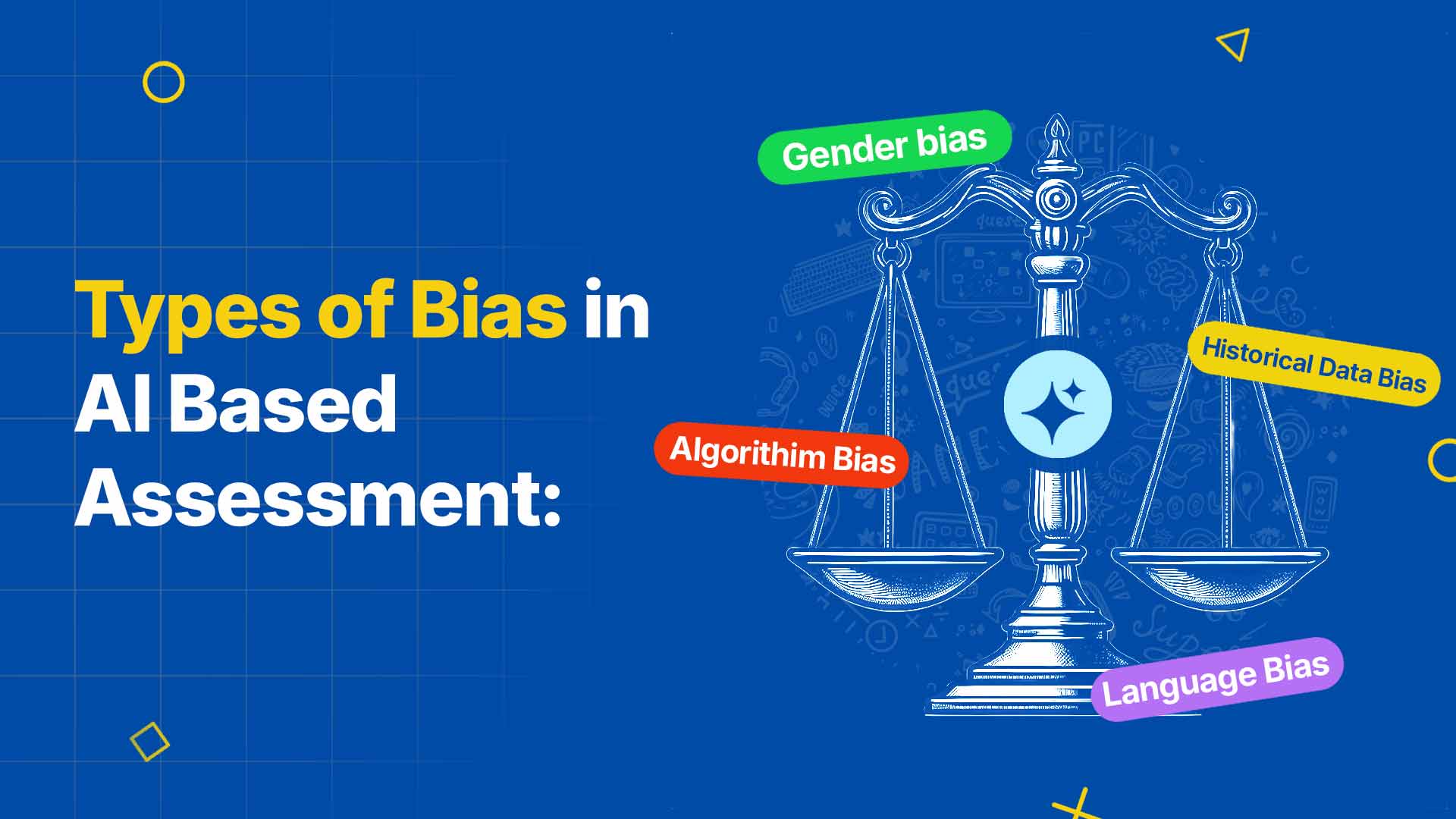
Artificial intelligence has redefined hiring, and modern ai assessment tools now enable faster, data-driven decisions across industries. Organizations rely on these systems to evaluate skills, behavior, and potential with unprecedented efficiency and scale.
Yet efficiency alone does not guarantee fairness. The real challenge lies in understanding how bias can quietly shape outcomes within these systems. Recognizing the types of bias in AI based assessment is essential for building responsible hiring strategies.
When bias enters AI systems, it does not appear obvious or intentional. Instead, it operates subtly through data, design choices, and evaluation methods. This makes it critical for talent leaders to actively identify and mitigate these risks.
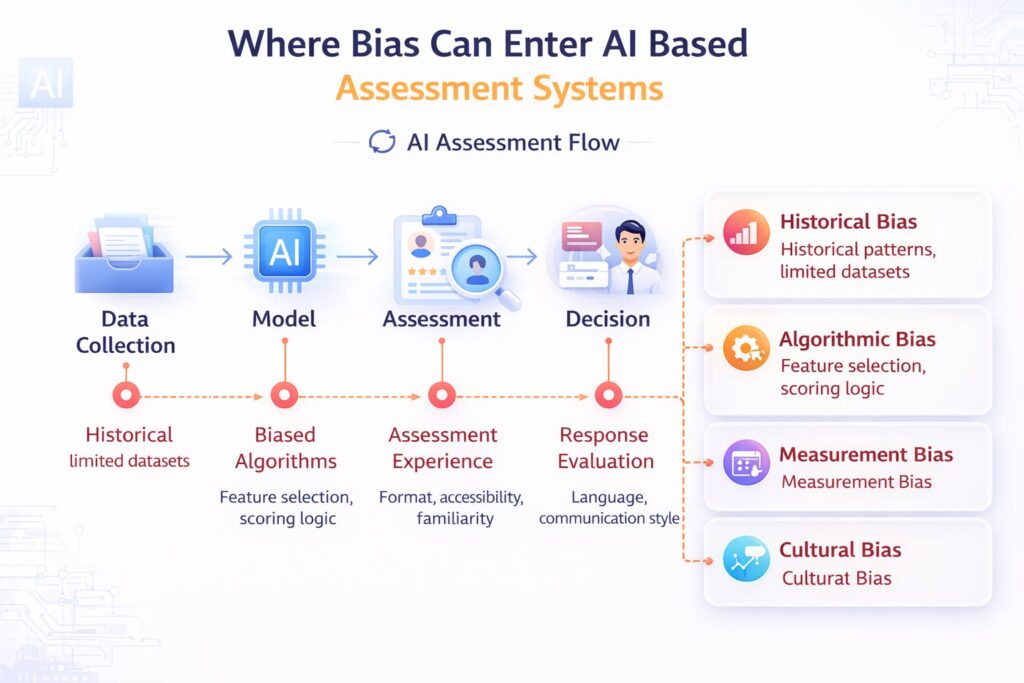
Understanding Bias in AI Assessment Systems
Bias in AI assessments refers to systematic errors that lead to unfair outcomes for certain candidate groups. These errors can originate from data, algorithms, or even how assessments are designed and interpreted.
Organizations often assume AI removes human bias completely. In reality, AI reflects the environment it is trained in. If that environment contains imbalance, the system may reproduce those same patterns at scale.
This is why awareness is the starting point. Once leaders understand where bias comes from, they can design assessments that are not only efficient but also inclusive and equitable for all candidates.
Top 7 Hiring Bias in AI Assessments
The most common types of bias in AI based assessment influence hiring outcomes in subtle but impactful ways. Understanding these biases helps organizations identify risks and improve fairness across AI-driven evaluation processes.
Historical Data Bias in Hiring Models
Historical data bias occurs when AI systems learn from past hiring decisions that were not fully objective. These patterns become embedded in the model and influence future candidate evaluations in similar ways.
For example, if previous hiring favored graduates from elite universities, the system may assign higher scores to similar profiles. This happens even when candidates from other backgrounds demonstrate equal or stronger capabilities.
The risk here is not just unfairness but missed potential. Organizations may overlook diverse talent pools simply because the system is trained to recognize familiarity instead of capability.
Algorithmic Bias in Scoring Systems
Algorithmic bias emerges from how models are designed and optimized. Even with balanced data, certain variables can disproportionately influence outcomes if they are weighted incorrectly or interpreted without context.
Consider a scenario where communication style is heavily weighted in scoring. Candidates from cultures that value brevity may receive lower scores compared to those with more expressive communication styles, despite equal competence.
This type of bias is often difficult to detect because it exists within the logic of the system itself. Without transparency and testing, it can quietly distort hiring decisions over time.
Measurement Bias in Assessment Design
Measurement bias occurs when the assessment method does not equally capture the abilities of all candidates. This often happens when assessments are designed without considering accessibility, familiarity, or different learning styles.
For instance, a gamified assessment may require quick reactions and digital familiarity. A highly capable candidate who is less experienced with such interfaces may perform poorly, even though their core skills are strong.
This creates a gap between actual ability and measured performance. Organizations risk rejecting strong candidates simply because the assessment format does not align with their strengths.
Language and Cultural Bias in AI Evaluation
Language and cultural bias arises when AI systems evaluate communication in ways that favor specific linguistic or cultural norms. This is common in assessments involving written or spoken responses.
Imagine a candidate answering a video interview question with clear but simple language. Another candidate uses more complex vocabulary. The system may rate the latter higher, even if both responses demonstrate equal insight.
Such bias limits access to global talent. It places unnecessary emphasis on style rather than substance, which can reduce diversity in hiring outcomes across regions and backgrounds.
Confirmation Bias in Model Development
Confirmation bias enters when AI systems are built around predefined ideas of what a successful candidate looks like. These assumptions often reflect existing organizational preferences rather than objective performance indicators.
For example, if leadership believes extroverted individuals perform better in sales roles, the model may prioritize traits associated with extroversion. This excludes high-performing candidates with different personality styles.
The consequence is a narrow talent pipeline. Organizations may unintentionally filter out individuals who could bring new perspectives, innovation, and long-term value to the business.
Interaction Bias Through User Behavior
Interaction bias develops over time as AI systems learn from how users interact with them. Recruiter decisions, overrides, and feedback can influence how the system evolves and makes future recommendations.
For instance, if recruiters consistently favor candidates from certain backgrounds, the system may adapt and begin ranking similar profiles higher. This creates a feedback loop that reinforces existing preferences.
This type of bias highlights an important truth. AI systems are not independent. They are shaped continuously by human behavior, which means accountability must extend beyond the technology itself.
Evaluation Bias in Performance Metrics
Evaluation bias occurs when AI systems are assessed using metrics that do not capture fairness across different groups. High overall accuracy can hide unequal performance among diverse candidate segments.
For example, an assessment tool may show strong accuracy overall but perform poorly for candidates from specific regions. Without subgroup analysis, this issue remains invisible and continues affecting hiring outcomes.
This creates a false sense of reliability. Organizations may trust the system completely while overlooking the fact that it is not delivering consistent results for all candidates.
Summary of Bias Types and Practical Impact
| Bias Type | Practical Impact on Hiring |
|---|---|
|
Historical Data Bias |
Reinforces past hiring patterns and limits diversity |
|
Algorithmic Bias |
Distorts scoring due to flawed model design |
|
Measurement Bias |
Misrepresents candidate ability because of the assessment format |
|
Language and Cultural Bias |
Penalizes candidates based on communication style |
|
Confirmation Bias |
Narrows talent pool based on assumptions |
|
Interaction Bias |
Reinforces recruiter preferences over time |
|
Evaluation Bias |
Hides unfair outcomes behind overall accuracy |
Building Fairer AI Assessments with Intent
The future of hiring is not just intelligent, it is intentional. If we do not design for fairness, we design for repetition. Bias is not something we eliminate entirely, it is something we continuously recognize, question, and reduce. With human-in-the-loop systems like C-Factor AI, we bring context, judgment, and realism into AI driven decisions, ensuring technology supports fairness rather than distorts it.
Paul Keijzer, CEO of The Talent Games
Fair AI assessment requires deliberate effort at every stage. From data selection to model design and ongoing monitoring, each step must align with the goal of equitable talent evaluation.
Solutions like C-Factor AI by The Talent Games focus on behavioral insights, diverse datasets, and continuous validation. This approach ensures that assessments measure potential rather than background or familiarity.
Organizations that prioritize fairness do more than avoid risk. They unlock access to broader talent pools, improve decision quality, and strengthen their employer brand in competitive markets.
Final Checklist for Reducing Bias in AI Assessments
-
Audit training data regularly for diversity and representation
-
Test assessment outcomes across different demographic groups
-
Ensure assessment design supports multiple ways to demonstrate ability
-
Monitor recruiter interactions with AI systems consistently
-
Combine accuracy metrics with fairness indicators
Closing Perspective on Responsible AI Hiring
Understanding the types of bias in AI based assessment gives organizations a clear advantage in building fair and high-impact hiring systems. It enables talent leaders to move beyond surface-level efficiency and adopt gamified assessments powered by unbiased algorithms that focus on real behavior and decision-making.
AI will continue to shape the future of hiring, but outcomes will depend on how responsibly it is designed and applied. Platforms like C-Factor AI, with agent-based assessment models, help organizations create more realistic, transparent, and fair evaluation processes that go beyond traditional methods.
FAQs
What are the main types of bias in AI based assessment?
The key types include historical data bias, algorithmic bias, measurement bias, language and cultural bias, confirmation bias, interaction bias, and evaluation bias. Each one affects how fairly candidates are assessed.
How does bias in AI hiring tools impact recruitment outcomes?
Here’s the reality. Bias in AI hiring tools can quietly filter out qualified candidates, reduce diversity, and lead to repetitive hiring patterns that limit innovation and long term performance.
Can AI talent assessment tools ever be completely unbiased?
Not entirely. AI reflects the data and systems it is built on. The real goal is to continuously identify, monitor, and reduce bias rather than assuming it can be fully eliminated.
What causes bias in AI based hiring assessments?
Bias typically comes from three places: training data, algorithm design, and human interaction with the system. If any of these are flawed, the output will be too.
How does C-Factor AI reduce bias in AI based assessment?
C-Factor AI uses agent-based AI models that evaluate behavior and decision-making rather than surface-level factors. This helps reduce reliance on biased historical patterns and improves fairness in candidate evaluation.
What makes C-Factor AI different from traditional AI assessment tools in terms of bias?
Unlike traditional systems that rely heavily on static scoring models, C-Factor AI introduces dynamic, agent-based evaluation. This allows for more contextual and realistic assessment, reducing algorithmic and measurement bias.
How do agent-based AI tools help minimize bias in hiring?
Think of it this way. Instead of rigid scoring, agent-based AI simulates real-world scenarios and evaluates responses. This reduces bias linked to language, background, or familiarity with test formats.
Can C-Factor AI handle cultural and language bias effectively?
Yes, to a significant extent. By focusing on behavior and decision-making rather than communication style alone, C-Factor AI minimizes the impact of linguistic and cultural differences in assessments.
What is a real example of bias in AI talent assessment tools?
A common example is when AI favors candidates with certain communication styles or educational backgrounds. This can exclude equally capable individuals who do not fit those patterns.
What should companies look for in low-bias AI assessment tools?
Look for systems that offer transparency, continuous monitoring, diverse datasets, and human-in-the-loop capabilities. If the tool explains decisions clearly, it is already a step toward fairness.