

Hiring assessments were once a quiet, background step in recruitment. Candidates completed tests, recruiters reviewed scores, and the process moved on. That no longer holds true in 2026.
Even assessment methods that trended just last year are rapidly changing as AI tools surge across recruitment.
Candidates, especially digital natives, are tired of outdated, opaque screening. They expect hiring to be engaging, transparent, and tech-driven. Today, assessments are experiences that shape employer brand, trust, and candidate commitment.
Who Is the Next Generation of Candidates?
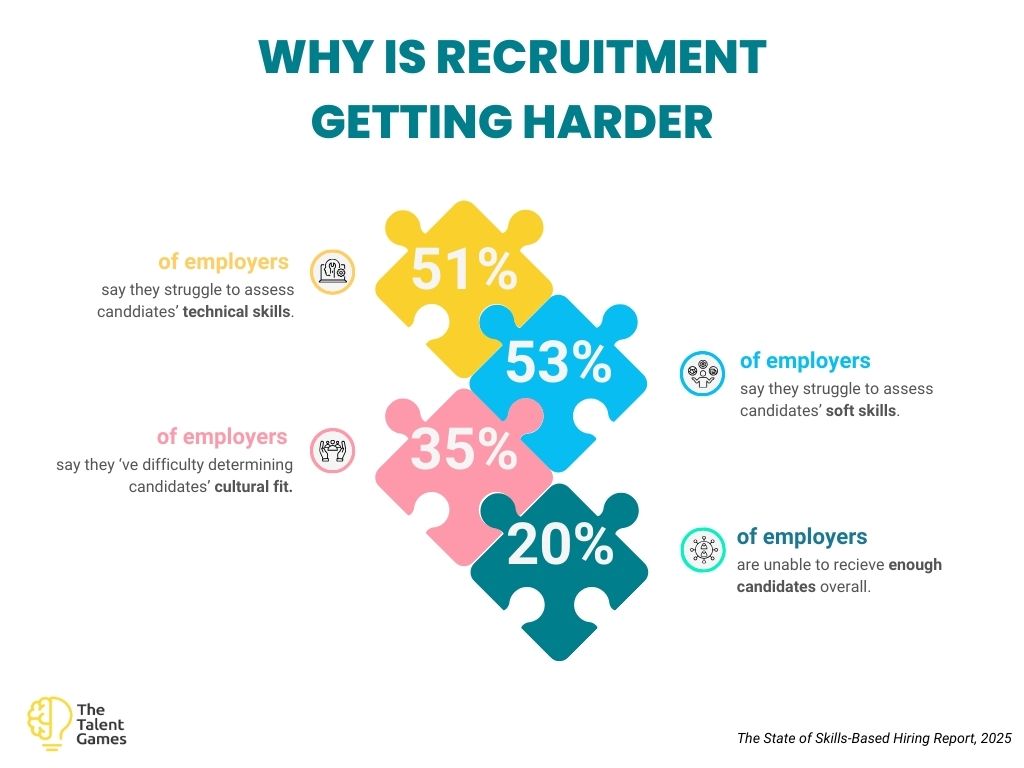
The next generation of candidates mainly includes Generation Z (born roughly between 1997 and 2012) and younger Millennials (mid-20s to early 30s) who are now entering or early into the workforce.
They grew up in an environment shaped by technology, feedback loops, and personalization.
They are comfortable interacting with AI, chatbots, and digital avatars. They expect processes to be intuitive, fast, and relevant. At the same time, they are more aware of issues like bias, fairness, and transparency than previous generations.
This group does not reject assessments. They reject assessments that feel outdated, irrelevant, or disconnected from the role they applied for.
For them, how a company assesses talent says a lot about how that company thinks about people.
Why Traditional Hiring Assessments Are Falling Short
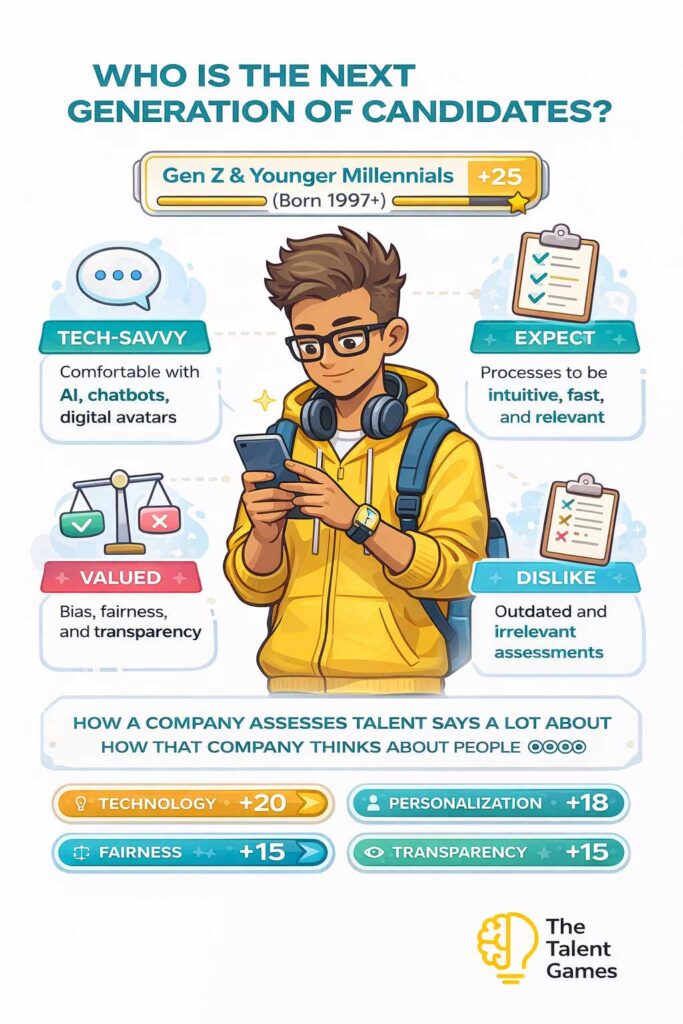
Many hiring assessments still follow models designed for a very different workforce.
Common issues include long and generic tests that feel disconnected from the job, static questionnaires that assume all candidates should be assessed the same way, and little to no communication about how results will be used.
From a candidate’s perspective, these hiring assessments often feel like effort without context. They do not see how the test reflects the role. They do not receive feedback. They do not feel engaged.
When that happens, even strong employer brands can take a hit. Candidates associate the frustration they feel during assessment with the organization itself.
How You Can Meet Candidate Expectations from Your Assessments in 2026
Meeting modern candidate expectations requires a shift in how assessments are designed, delivered, and experienced. Technology plays a central role here, but only when it is applied thoughtfully.
Moving from Static Tests to AI-Based Assessment Design
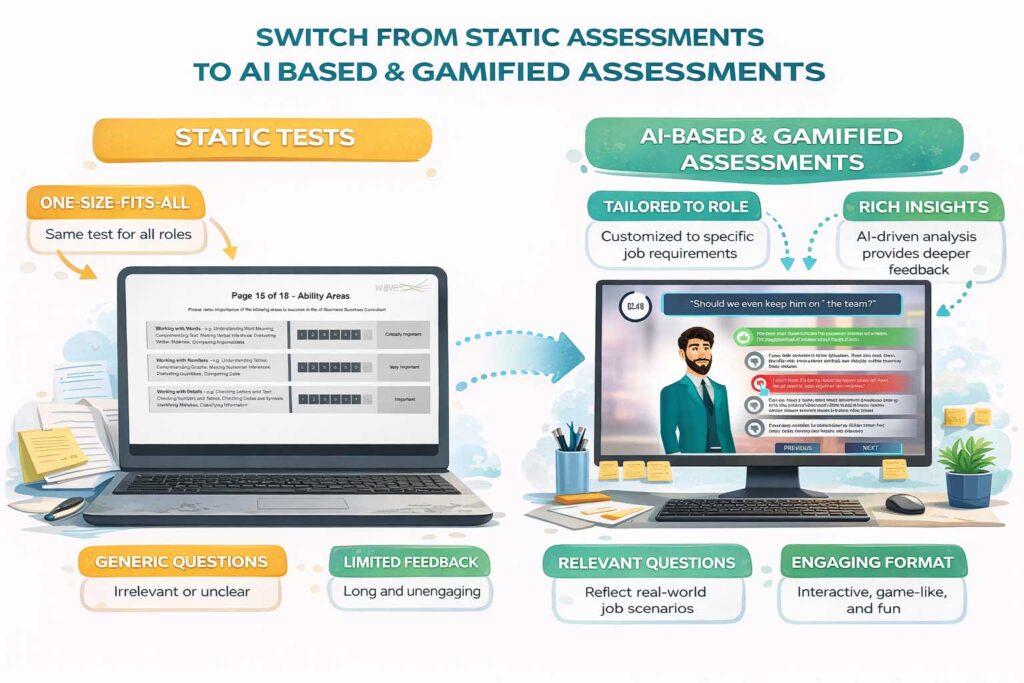
AI-based platforms allow organizations to move away from one-size-fits-all assessments. Instead of starting with a fixed test, the process can begin with the role itself.
AI can help translate job requirements into relevant competencies, recommend appropriate assessment methods, and adapt difficulty or focus based on role context. This makes the assessment feel purposeful rather than generic.
For candidates, this shows respect for their time and signals that the organization understands what the role actually requires.
Using AI Agents to Create a More Human Digital Experience
One of the biggest shifts in modern assessment platforms is the use of AI agents that handle different stages of the hiring journey.
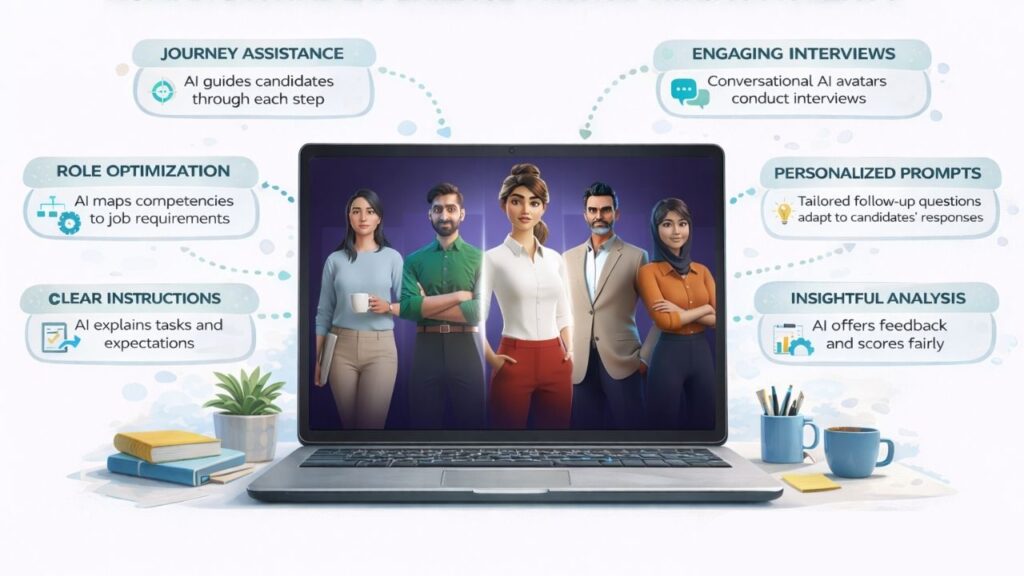
For example, in AI-based platforms like C-Factor AI, different AI agents work together across the process. One agent supports job creation and competency mapping. Another engages candidates through conversational interviews. Others handle scoring, analysis, and insight generation.
From a candidate’s point of view, this feels less like interacting with a rigid system and more like a guided experience. An AI avatar or interviewer can explain instructions, ask follow-up questions, and create a sense of interaction rather than isolation.
This matters because candidates often judge fairness and professionalism based on how clearly the process communicates with them.
How C-Factor AI Creates Human Digital Experience with Avatar Based AI Agents
Combining AI Avatars with Gamified Assessments
Engagement alone is not enough. Assessments still need to measure skills accurately and consistently.
This is where gamified assessments, when designed properly, play an important role. Mini games, situational judgement tests, and interactive scenarios can assess cognitive abilities, decision-making, and behavioral traits without feeling like traditional exams.
Platforms like The Talent Games use situational judgement tests and mini games to assess multiple competencies in a structured way. When combined with AI-driven delivery and scoring, these assessments can capture rich behavioral data while keeping candidates engaged.
The key is balance. Gamification should support measurement, not distract from it. When done well, candidates feel challenged and interested, not entertained for entertainment’s sake.
The Role of Fairness, Transparency, and Trust
Next-generation candidates care deeply about how decisions are made and that requires reliable candidate assessment tools.
AI often raises questions about bias, but when implemented responsibly, it can actually improve fairness. Consistent scoring, standardized evaluation criteria, and reduced reliance on subjective judgement help create more defensible hiring decisions.
What matters is transparency. Candidates do not need to see the full scoring model, but they do want to understand what is being assessed and why.
Clear communication, structured assessment logic, and even light feedback at the end of the process can significantly improve how candidates perceive fairness.
Why Gamified Assessments Improve Candidate Experience When Used Correctly
Gamified assessments are sometimes misunderstood. They are not about turning hiring into a game. They are about using interactive formats to observe how candidates think, react, and decide.
Situational judgement tests simulate real workplace scenarios. Mini games can reveal patterns in attention, problem-solving, or adaptability. Together, they allow employers to assess multiple competencies in a short amount of time.
For candidates, this feels closer to real work and less like memorization or trick questions. That relevance improves engagement and completion rates, which directly impacts hiring outcomes.
The Employer Brand Impact of Modern Assessments
Every touchpoint in hiring sends a message. Assessments are no exception.
A well-designed, AI-supported assessment experience signals that an organization values innovation, fairness, and candidate experience. A poorly designed one suggests the opposite.
Candidates talk. They share experiences on social platforms and employer review sites. Even candidates who are not hired carry perceptions forward into future applications, referrals, and brand advocacy.
Organizations that treat assessments as part of their employer brand strategy, rather than just a screening step, tend to build stronger long-term talent pipelines.
Why Integrated Assessment Platforms Matter More Than Ever
One common issue in hiring is fragmentation. Different tools handle job posting, screening, interviewing, and scoring. This creates inconsistencies and breaks the candidate experience.
Integrated AI-based assessment platforms solve this by connecting job creation, assessment design, candidate interaction, and analytics into one flow.
When AI agents work together across these stages, the experience becomes more coherent for both candidates and recruiters. Candidates receive consistent communication. Recruiters gain clearer insights without manual data stitching.
This integration is especially important when using advanced methods like AI avatars and gamified assessments, where context and continuity matter.
Designing Assessments for the Next Generation
Organizations looking to modernize their assessment approach should focus on a few core principles.
Start with role clarity, not tests. Design assessments around real competencies and scenarios. Use AI to support consistency and scalability, not to replace human judgement entirely.
Prioritize engagement, but never at the cost of validity. Make the experience interactive, but ensure it measures what actually predicts success.
Most importantly, treat assessments as a reflection of your organization’s values. Candidates notice the difference.
Closing Thoughts
The next generation of candidates does not expect hiring to be perfect. They expect it to be thoughtful.
AI-based platforms, AI agents, and gamified hiring assessments offer powerful ways to meet those expectations when they are applied with intent and care. They help organizations assess skills more effectively while delivering experiences that candidates respect and remember.
In a competitive talent market, that combination is no longer optional. It is becoming the standard.