

In a recent hiring program for a management trainee role at a leading food and beverage company, we analyzed candidate performance across multiple competencies through our gamified assessments.
One insight stood out clearly.
Numerical reasoning recorded the lowest average score among all assessed areas.
This was not about complex calculations. It reflected how candidates interpreted data, understood trends, and made decisions based on numbers.
For organizations hiring future managers, this insight is worth paying attention to. For candidates, it highlights an area that directly impacts performance in real roles.
What Is Numerical Reasoning for Trainees and Why It Matters?
Numerical reasoning for trainees refers to the ability to understand, interpret, and make decisions using data.
It is not about solving mathematical equations. It is about making sense of numbers in practical situations.
Trainees, especially in management programs, are expected to:
- Analyze performance reports
- Understand sales trends
- Evaluate operational data
- Support decision-making
The ability to work with numbers is closely tied to how effectively a trainee can contribute to business outcomes. It is one of the top competencies employers seek in managers.
Recent studies also reinforce this. According to the State of Data Literacy Report 2024, 86% of business leaders consider data literacy essential for day-to-day work, highlighting the growing importance of numerical reasoning in real-world roles.
Without this skill, decisions may rely more on assumptions rather than insights. With it, trainees can make clearer, more confident contributions from an early stage in their careers.
What the Data about Numerical Reasoning for Management Trainees Shows
Based on assessment results from the hiring program, numerical reasoning had the lowest average score compared to other competencies.
| Competency | Average Score |
|---|---|
|
Focused Attention |
65.58 |
|
Drive For Results |
59.75 |
|
First Impression |
59.10 |
|
Building Bridges |
55.48 |
|
Formula for Success |
52.01 |
|
Innovation |
40.84 |
|
Inductive Reasoning |
38.73 |
|
Planning |
36.00 |
|
Numerical Logic |
31.30 |
This gap indicates that while candidates demonstrate strength in communication and collaboration, interpreting and acting on data remains a challenge.
Insight from Leadership
“Hiring today is no longer about what candidates say, but how they think and decide in real scenarios.”
Paul Keijzer, CEO of The Talent Games
When it comes to numerical reasoning, this insight becomes even more relevant. Numbers reveal how candidates approach decisions and how comfortable they are working with real-world information.
Why This Gap Exists Between Other Competencies and Numerical Reasoninng
Numerical reasoning is not always a focus area during early education or interview preparation.
Many candidates are comfortable with theoretical questions but find it challenging to apply numerical thinking in practical scenarios.
Another factor is exposure. Trainees may not have had enough opportunities to work with real datasets, reports, or business metrics before entering hiring processes.
From personal experience working on assessment design, candidates often hesitate when data is presented in context. That hesitation usually reflects uncertainty in translating numbers into actionable insights.
5 Ways to Improve Numerical Reasoning for Trainees
Improving numerical reasoning is not about advanced mathematics. It is about building confidence in understanding and using data effectively.
Here are these 5 ways to improve it:
1. Practice with Real-World Data
Instead of solving random numerical questions, start using actual business data. Look at sales reports, marketing dashboards, or even simple Excel sheets. Try to understand what changed, why it changed, and what action you would take if you were responsible.
2. Focus on Interpretation
Do not stop at reading numbers. Always ask what the numbers are trying to tell you. If sales dropped by 10 percent, think about possible reasons and next steps. This habit builds decision-making, not just number-reading ability.
3. Break Down Information
When faced with complex data, avoid trying to understand everything at once. Start by identifying one clear insight at a time. For example, first look at trends, then compare values, and then think about outcomes. This reduces confusion and improves clarity.
4. Use Scenario-Based Learning
Put yourself in situations where numbers actually matter. For example, imagine you are managing a store and sales are declining. What would you check first? Scenario-based thinking helps you connect numbers with real decisions and actions.
5. Build Consistency
Numerical reasoning improves with regular exposure, not one-time effort. Spend a few minutes daily reviewing charts, reports, or even business news with data. Over time, numbers will start feeling familiar, and your confidence in handling them will naturally increase.
Conclusion
Numerical reasoning for trainees is a key skill that directly influences how effectively future managers can perform. Based on insights from real hiring programs, The Talent Games consistently observes a clear opportunity for both candidates and recruiters to strengthen this area.
For candidates, developing numerical reasoning improves readiness for real-world roles where decisions are driven by data. For recruiters, assessing this competency enables more informed, objective hiring decisions. Because ultimately, the ability to understand numbers is the ability to make better decisions.
FAQs
1. What is numerical reasoning for trainees in hiring programs?
Numerical reasoning for trainees refers to a candidate’s ability to interpret data, understand numerical information, and make decisions based on real-world business scenarios during assessments or hiring processes.
2. Why is numerical reasoning for trainees important in management trainee roles?
Management trainees are expected to analyze reports, track performance, and support decision-making. Numerical reasoning helps them understand data clearly and contribute effectively from the early stages of their careers.
3. How is numerical reasoning for trainees assessed during recruitment?
It is typically assessed through data interpretation questions, charts, case-based scenarios, or gamified assessments that simulate real workplace situations where candidates must make decisions using numbers.
4. What are common challenges in numerical reasoning for trainees?
Many trainees struggle with interpreting data in context, identifying trends, and translating numbers into decisions. The challenge is usually not calculation but understanding what the numbers actually mean.
5. How can candidates improve numerical reasoning for trainees roles?
Candidates can improve by practicing with real datasets, analyzing reports, and engaging in scenario-based exercises that require decision-making using numbers rather than just solving theoretical questions.
6. What types of questions are included in numerical reasoning for trainees assessments?
These may include interpreting graphs, analyzing tables, identifying trends, calculating percentages, and making business decisions based on numerical information presented in realistic scenarios.
7. How do gamified assessments measure numerical reasoning for trainees?
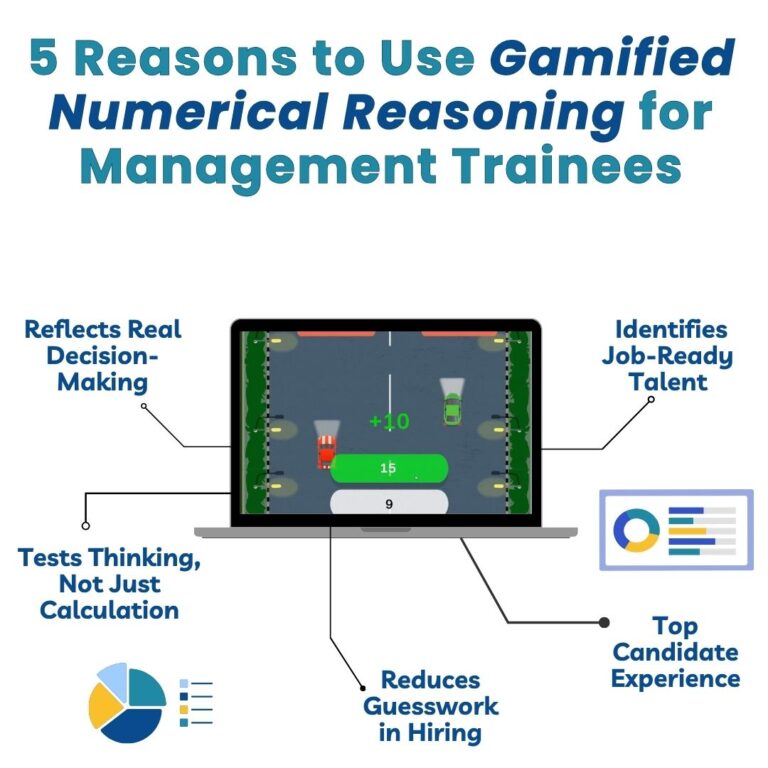
Gamified assessments present interactive scenarios where candidates must respond to data-driven situations. This helps evaluate how they think, interpret numbers, and make decisions under realistic conditions.
8. How does The Talent Games assess numerical reasoning for trainees?
The Talent Games uses gamified simulations and scenario-based assessments to measure how candidates interpret data and make decisions, providing deeper insights beyond traditional numerical tests.
9. Is numerical reasoning for trainees only important for finance-related roles?
No, numerical reasoning is relevant across all roles. Even in non-financial positions, trainees need to understand performance metrics, analyze trends, and make decisions based on data.
10. How does strong numerical reasoning for trainees impact future managerial performance?
Trainees with strong numerical reasoning are better equipped to make informed decisions, identify patterns, and manage performance effectively, which directly contributes to their growth into successful managers.