Hiring teams today are facing growing pressure in an AI-driven hiring market. Gartner reports that only 31% of recruiting teams use labor market data to guide talent strategy, while LinkedIn research shows 66% of recruiters still struggle to identify qualified candidates.
As application volumes rise and AI-assisted resumes become more common, the challenge is no longer attracting applicants. It is finding the right talent and identifying authentic capability beyond what appears optimized on paper.
Across different industries and hiring environments, one challenge remains consistent: how do you identify real signal when nearly every candidate appears qualified on paper? Here are the insights and how they can be applied to build a stronger, more effective screening approach.
3 Key Factors for Screening Candidates to Finding the Right Talent
These are the key ways teams are improving how they screen candidates to find the right talent. They reflect a more structured and focused approach to identifying what truly matters:
Start by defining what “qualified” actually means
It sounds straightforward. But one of the most common reasons screening fails is misalignment between recruiters and hiring managers on what “good” actually looks like. The problem is, this gap often only becomes visible once candidates are already moving through the pipeline.
A more effective approach is to anchor expectations early using real examples. Instead of relying only on role descriptions or kickoff discussions, high-performing teams review a set of actual candidate profiles before the search gains momentum. Looking at 5 to 10 real profiles helps bring clarity to what the role truly requires.
Why does this matter? Because what stakeholders describe in an initial discussion and how they respond to real candidate backgrounds are often very different. Assumptions shift quickly when faced with actual profiles, and that is where alignment either strengthens or breaks.
As one hiring leader put it, “What gets defined in a kickoff rarely holds up when real candidates enter the conversation. You start seeing preferences change, expectations evolve, and sometimes completely new criteria emerge. That is why aligning on both the role and real candidate profiles early makes all the difference.”
That calibration step changes everything downstream. When hiring criteria are tested against real profiles early on, teams move away from assumptions and start evaluating candidates based on what decision-makers are actually willing to move forward with.
Another critical point often missed when application volume increases is that strong pipelines do not come from a single source. Especially in early-stage or scaling environments where inbound applications may be limited or inconsistent, relying on just one channel creates gaps. High-performing teams actively build from multiple sources including referrals, internal networks, past candidates, and outbound sourcing efforts.
Pipeline building is not a one-time setup. It is an ongoing process that requires constant adjustment. Depending only on inbound applications limits access to quality talent. A more effective approach is to treat pipeline creation as a connected system rather than a single channel strategy.
“Building a strong pipeline is not about waiting for the right candidates to apply. It is about continuously refining where and how talent is sourced, and staying flexible in how different channels contribute to the overall hiring effort.”
Paul Keijzer, CEO The Talent Games
The teams that consistently screen well are those that have already built pipelines broad enough to surface candidates who may not have discovered the opportunity on their own.
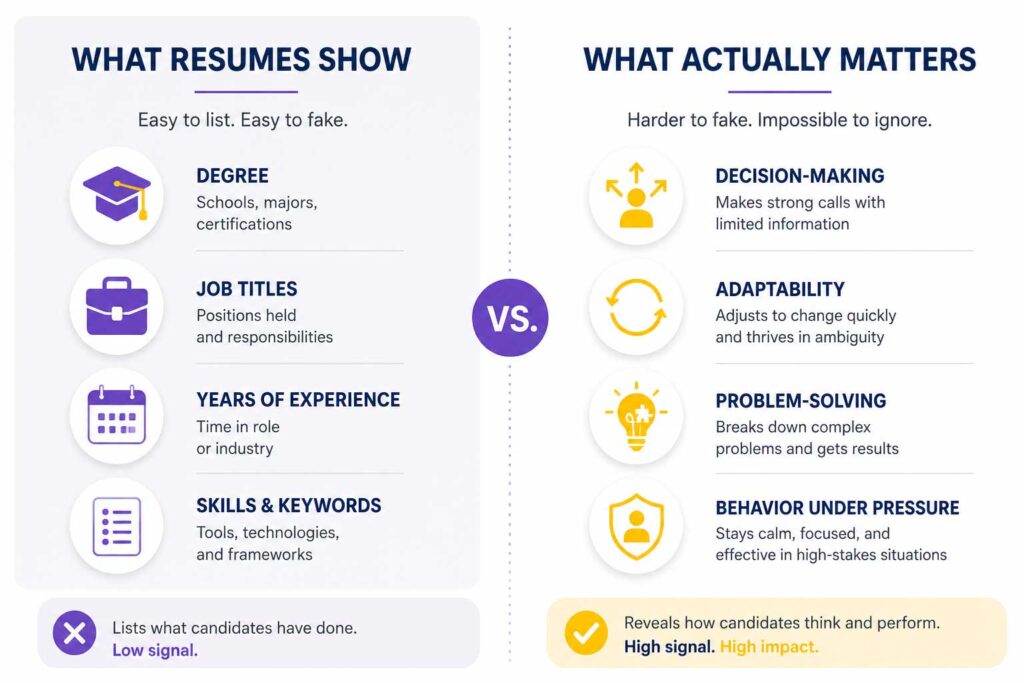
Focus on signal as proof of capability, not a checklist of credentials
This becomes even clearer when viewed from the candidate side.
Consider a non-traditional career path. Before stepping into recruitment, some professionals come from completely unrelated industries, often without a formal degree or a background that neatly fits a job description. On paper, these profiles can easily be overlooked in a high-volume screening process. Yet, when given the opportunity, they go on to build high-performing teams and play a critical role in scaling organizations.
What stood out in these cases was not a perfect resume. It was how they approached problems, adapted to challenges, and delivered results in demanding environments. Experiences shaped outside conventional career paths often develop qualities like resilience, decision-making under pressure, and resourcefulness.
These are not traits you find listed clearly in a CV. They show up in how someone works.
As one hiring professional shared, “I learned early on not to wait for ideal conditions because they rarely exist. Working in high-pressure environments forces you to act, adapt, and keep moving forward. That mindset builds confidence based on preparation, not ego.”
The takeaway is simple. Strong candidates are not always the most obvious ones. Real signal comes from demonstrated behavior, not just documented experience.
If your screening criteria rely too heavily on degrees, job titles, or perfectly linear career paths, you will filter out candidates with high potential. And in a market where the strongest talent does not always follow a conventional trajectory, that kind of filtering becomes a serious disadvantage.
The risk is not just missing candidates. It is overlooking individuals who bring adaptability, resilience, and problem-solving ability that cannot be captured through keywords alone.
Prioritize trust as a critical signal in candidate screening
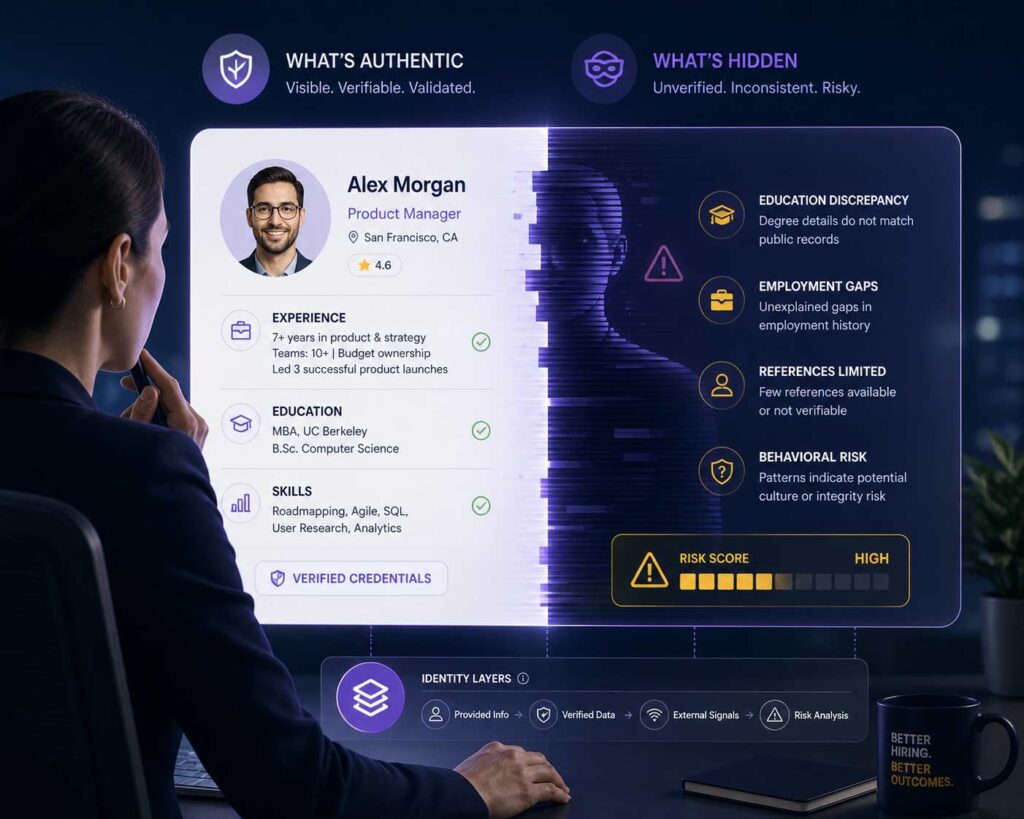
High application volume and unclear criteria are one side of the screening challenge. The other is trust, and the risk is growing quickly.
In certain industries, this risk is already very real. Organizations hiring for sensitive or high-stakes roles are seeing an increase in identity fraud, fabricated profiles, and candidates misrepresenting their experience. In extreme cases, there have even been reports of coordinated attempts to gain access to organizations through hiring processes.
“Recruiters working in high-risk environments are not just filling roles. They are protecting the integrity of the organization. If that responsibility does not create urgency, nothing will.”
This is not limited to a single sector. Research shows that 91 percent of recruiters and hiring managers have encountered or suspected some form of candidate misrepresentation. At the same time, more than 40 percent of candidates admit to using tactics to bypass screening systems, while over half of those who have not tried it say they would consider doing so.
That creates a clear trust gap that hiring teams cannot ignore.
There is also an important distinction to consider as more organizations adopt AI-driven screening tools. Technology can process large volumes of data and highlight patterns, but it does not replace true evaluation.
"You cannot rely on technology alone if the underlying process is weak. AI helps review information, but finding the right talent requires more than automated filtering. It is still the recruiter’s role to go deeper, validate, and understand what is behind the profile."
Paul Keijzer
AI can support efficiency at the top of the funnel. But assessing judgment, adaptability, and trust still depends on human interaction and deeper evaluation beyond the surface.
Five ways to screen smarter in a high-volume hiring environment
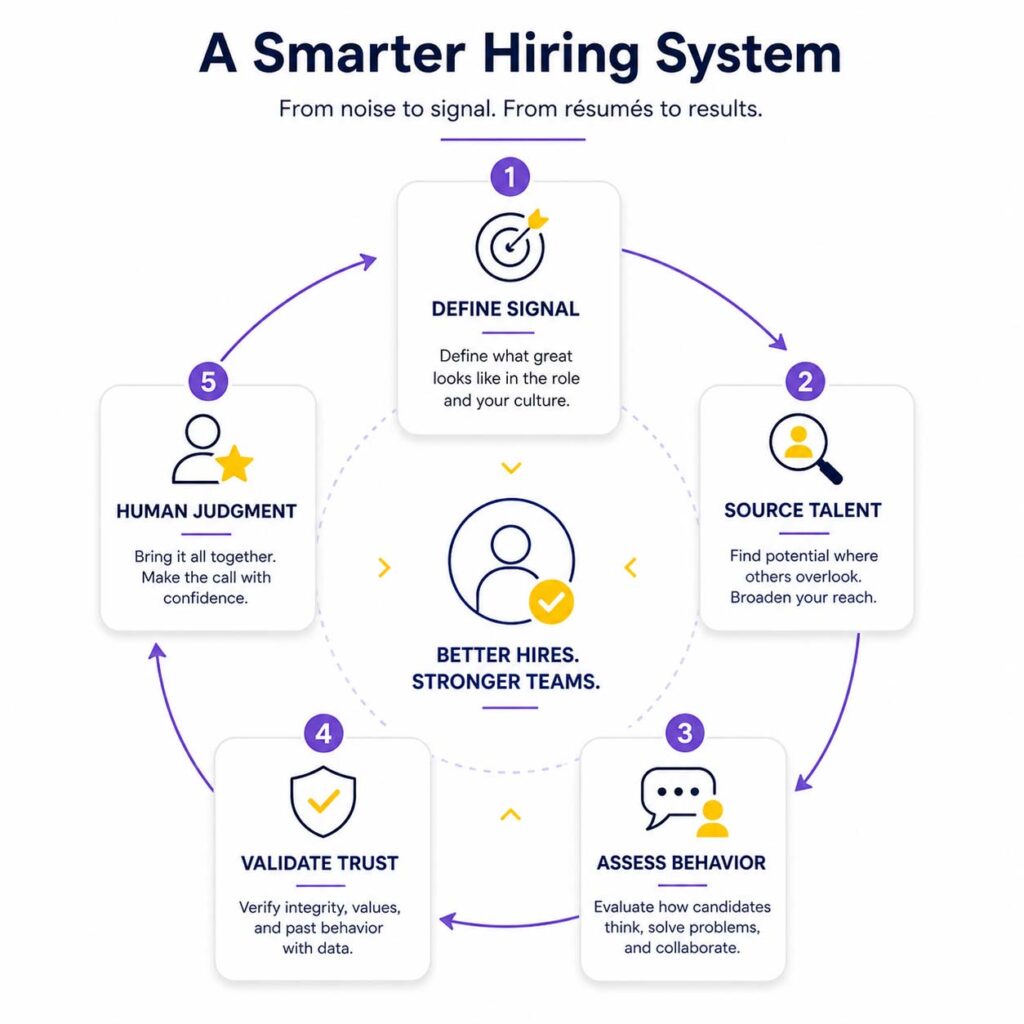
Across these insights, a clear pattern emerges for teams that want to improve screening without compromising on quality.
Define signal before screening begins.
Align early on what “qualified” actually means for the role and what truly defines finding the right talent. Use structured scorecards and review real candidate profiles, not just job descriptions, to remove ambiguity.
Build pipelines across multiple channels.
Relying only on inbound applications limits access to strong talent. Combine outbound sourcing, referrals, past candidates, and network-driven outreach to expand your reach.
Verify authenticity early in the process.
As candidate misrepresentation becomes more common, it is important to introduce validation steps early, especially for roles where accuracy and trust are critical.
Use AI to support, not decide.
AI can help identify patterns, highlight potential matches, and manage high application volumes more efficiently, but finding the right talent still requires human judgment and deeper behavioral understanding.
That is why platforms like C-Factor AI, the avatar-based AI assessment platform developed by the experienced team at The Talent Games, are designed to go beyond resumes and surface more authentic insights into candidate behavior, communication, and decision-making.
Ultimately, technology works best when it supports recruiters in understanding the context and capabilities that traditional data alone cannot fully capture.
Introduce intentional structure in evaluation.
Not every step needs to be frictionless. Structured interviews, clear evaluation criteria, and consistent assessment methods help maintain quality when dealing with high volumes.
The teams that hire well are the ones that see clearly
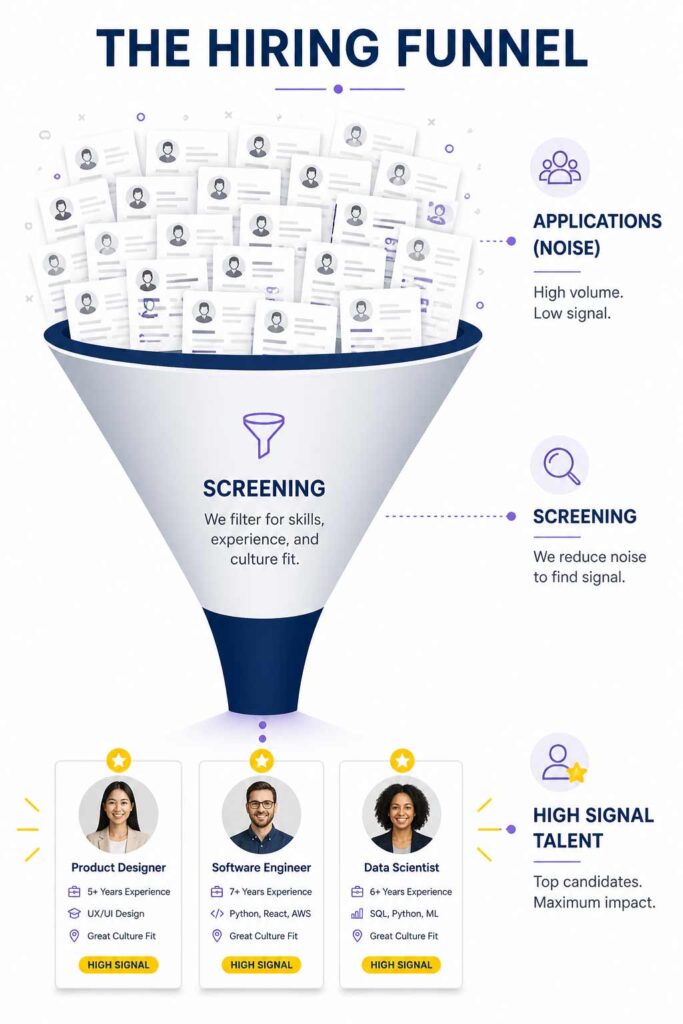
The top of the hiring funnel is only becoming more crowded. Application volumes continue to rise, candidates are becoming more optimized in how they present themselves, and hiring teams are expected to do more with fewer resources. But success in this environment is not about processing more applications. It is about clarity.
The teams that consistently make strong hiring decisions are those that know exactly what they are looking for and have the systems in place to identify it effectively.
That is the common thread across modern hiring practices. The right talent is out there, but finding it requires a more intentional approach to evaluation and decision-making. At The Talent Games, this is the challenge we aim to solve through modern hiring solutions like C-Factor AI, helping organizations identify stronger talent signals in an increasingly AI-driven hiring landscape.