

A practical student guide to preparation for gamified assessment in 2026, explaining what these assessments are and how to approach them calmly, confidently, and authentically.
If you’re graduating soon or applying for your first serious job in 2026, there’s a good chance you’ll face something called a gamified assessment. And if that already sounds confusing, you’re not alone.
A lot of students hear the word “game” and immediately think one of two things. Either it’s going to be fun and easy, or it’s going to be some kind of trick dressed up as fun. The truth sits somewhere in between.
Gamified assessments aren’t designed to entertain you, and they’re definitely not designed to trap you. They exist because hiring has changed, and because your generation thinks, learns, and works differently from the generations before it.
This blog is here to help you understand what’s really going on, how to prepare without overthinking it, and how to walk into a gamified assessment feeling calm, confident, and like yourself and not like you’re trying to beat a system.
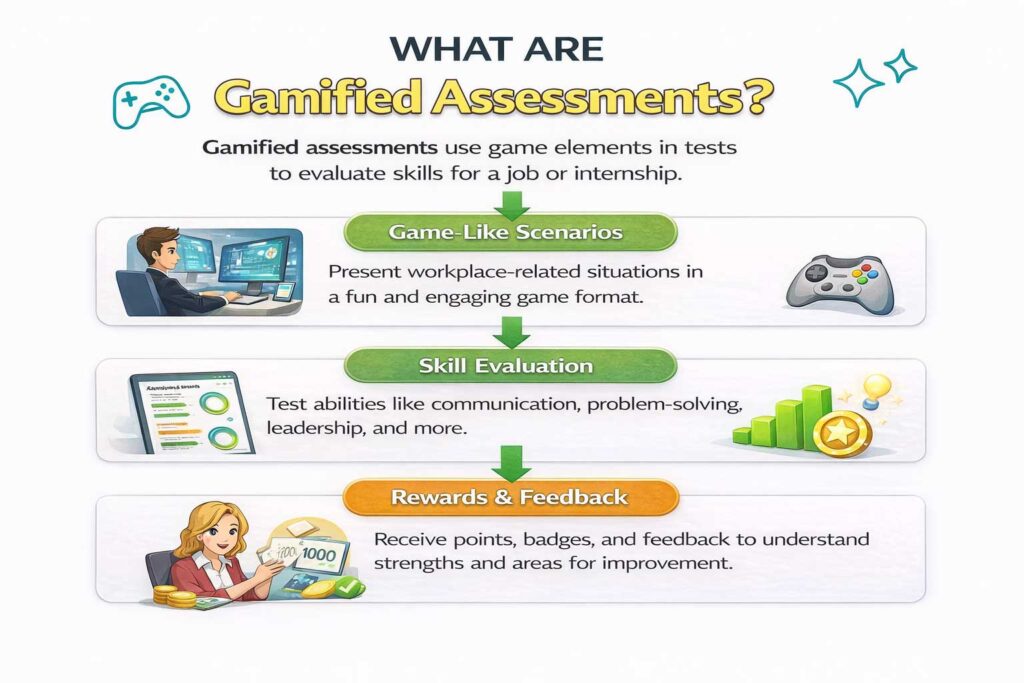
What Are Gamified Assessments?
Gamified assessments are structured hiring tools that use interactive tasks, simulations, and scenarios to understand how you think and respond in real situations. Instead of asking you direct questions about your skills, they observe your behavior while you’re doing something.
You’re not being tested on facts. You’re not being judged on how “fun” you are. And you’re not expected to know what’s coming next.
What companies are really looking at is how you approach unfamiliar situations. How you deal with uncertainty. How you make decisions when things aren’t perfectly clear. These are the same conditions you’ll face in an actual job.
That is why companies trust this format more than traditional tests. There’s also research to support that gamified assessments are more engaging and potentially effective tools for assessing job-relevant soft skills.
There’s usually no single right answer. What matters more is how consistent and thoughtful your decisions are over time.
Why Gamified Assessments Make Sense for Your Generation
Let’s be honest. Traditional hiring methods don’t always feel fair or relevant to students today. Long written tests, memorized answers, and pressure-heavy interviews often reward confidence in test-taking rather than real ability.
Your generation grew up learning by doing. You’ve adapted to new apps, new tools, and new ways of working your entire life. You’re used to figuring things out as you go.
Gamified assessments are built around that reality.
They allow companies to see how you learn, not just what you already know. They reduce bias by giving everyone the same experience. And they focus on potential rather than polish.
For you, that means your background, accent, or ability to “talk well” matters less than how you actually think.
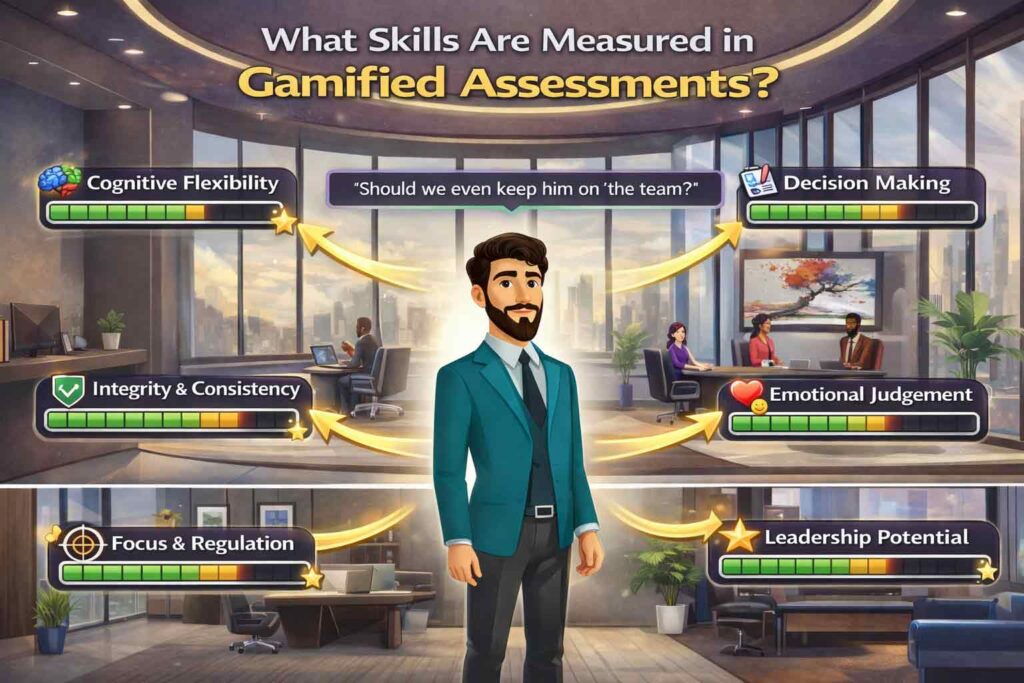
5 Common Skills Measured Through Gamified Assessments
Companies don’t use gamified assessments randomly. They’re designed to understand a small number of future-ready skills that matter far beyond your first job. Here is a list of few such skills:
• Cognitive flexibility
This is about how easily you adapt when rules change or new information appears. In real jobs, things rarely stay the same, and companies value people who can adjust without panicking.
• Decision-making under uncertainty
You won’t always have complete information at work. These assessments observe how you think when certainty isn’t available, which directly affects how you’ll perform in real situations.
• Emotional judgment
This reflects how aware you are of people, consequences, and impact. The companies really value the individuals with better emotional judgement.
• Integrity and consistency
Companies look for patterns that make sense over time. Consistency shows you’re genuine, reliable, and not just saying what sounds good.
• Focus and self-regulation
This matters more than ever in distraction-heavy work environments. It shows how you manage effort, attention, and pressure.
Unlike traditional tests, gamified assessments reveal real thinking and decision-making, which is why companies value these skills more than textbook knowledge.
5 Key Tips to Prepare for a Gamified Assessment in 2026
You’ve spent years mastering games on your phone (and pretending you weren’t playing them in class). Gamified assessments use that same comfort with interaction. Here are five tips to help you prepare the right way.
Tip 1: Shift Your Mindset From “Passing” to “Participating”
Gamified assessments are not exams. Approaching them like one often backfires.
Instead of asking:
“How do I get the highest score?”
Ask:
“How do I engage thoughtfully and consistently?”
Over-strategizing, second-guessing, or trying to appear “ideal” often introduces unnatural behavior patterns. Always remember that preparation starts with psychological readiness, not tactics.
Tip 2: Practice Decision-Making in Everyday Situations
You don’t need special tools to prepare.
Here are few of the daily habits that will help you:
- Reflect on why you made certain decisions
- Notice how you react under mild pressure
- Observe how you prioritize when time is limited
These micro-reflections strengthen self-awareness, which naturally translates into assessments. You’re training the mindset, not the mechanics.
Tip 3: Build Comfort With Ambiguity
Many candidates struggle not because tasks are hard, but because instructions feel incomplete. That is intentional.
You can practice by:
- Working through problems without immediately seeking confirmation
- Accepting that some decisions won’t feel “certain”
- Focusing on logic rather than reassurance
In modern roles, confidence comes from reasoning, not certainty.
Tip 4: Be Consistent, Not Performative
Trying to “sound right” often leads to inconsistent choices.
Instead:
- Respond in a way that feels natural to you
- Stick to your reasoning patterns
- Avoid switching approaches just because a task feels different
Assessments are designed to understand how you think, not to judge your personality, therefore, Consistency builds trust in your profile.
Tip 5: Take Care of Your Mental State Before the Assessment
This is underestimated. Before starting:
- Ensure you’re rested
- Choose a quiet environment
- Avoid rushing in emotionally charged moments
Gamified assessments observe patterns over time, and stress can distort those patterns. Preparation includes mental clarity, not just readiness.
How to Approach Gamified Situational Judgment Tests
Situational Judgment Tests, especially when gamified, place you inside realistic workplace scenarios. You’re asked to respond, choose, or prioritize actions based on what you think makes sense.
The biggest mistake students make here is trying to sound “perfect.”
Real workplaces don’t reward extreme reactions. They reward balance. These scenarios are designed to understand how you think through consequences, people, and outcomes — not whether you pick the most dramatic option.
If you focus on being reasonable and consistent, you’re already doing what the assessment is designed to see.
Final Thoughts
You don’t need to crack a system to succeed in a gamified assessment. You don’t need to pretend to be someone else. And you definitely don’t need to panic because it looks different from what you expected.
Show up calm. Show up curious. Show up honest.
That’s not just how you do well in a gamified assessment. It’s how you build a career that lasts.
At The Talent Games, that belief sits at the core of how we design assessments for the future of work.